
?What is Egg Freezing
A woman’s chances of conceiving naturally fall as she gets older because the quality and number of her eggs drops. Oocyte Cryopreservation or Egg Freezing, is one way of preserving a woman’s fertility in which a woman’s eggs (oocytes) are extracted, frozen and stored as a method to preserve reproductive potential in women of reproductive age. The first human birth from a frozen oocyte was reported in 1986. Oocyte cryopreservation has advanced greatly over the past few years, with improved overall success of eggs surviving the freezing process. It is no longer considered an experimental procedure by the American Society for Reproductive Medicine. The techniques leading to enhanced gamete survival, potential fertilization and live birth rates allow women a much greater degree of autonomy than was possible even in the past 5 years.
?Who Needs Egg (oocyte) Freezing
Cryopreservation of the oocytes can be considered for a variety of reasons:
Women with cancer requiring chemotherapy and/or pelvic radiation therapy that may affect fertility.
Surgery that may cause damage to the ovaries.
Risk of premature ovarian failure because of chromosomal abnormalities (e.g. Turner syndrome, fragile X syndrome), or family history of early menopause.
Ovarian disease with risk of damage to the ovaries.
Genetic mutations requiring removing the ovaries (e.g. BRCA mutation).
Fertility preservation for social or personal reasons to delay childbearing.
?Is egg freezing right for me
You might want to consider freezing your eggs if:
You have a medical condition or need treatment for a medical condition that will affect your fertility, such as cancer (in this case NHS funding may be available depending on where you live).
You’re worried about your fertility declining but you’re not ready to have a child or you haven’t found the right partner – this is often called ‘elective egg freezing’.
You’re at risk of injury or death (for example, you’re a member of the Armed Forces who is being deployed to a war zone).
If you’re a female transitioning to a male, you may want to preserve your fertility before you start hormone therapy or have reconstructive surgery. Both treatments can lead to the partial or total loss of your fertility.
You don’t want to have leftover embryos after IVF treatment for ethical reasons.
?What is the egg freezing process
To obtain eggs for freezing, a woman will usually have hormonal stimulation for 10 – 12 days, enabling a number of eggs (usually 6 – 15) to mature. There are a variety of stimulation techniques, and you will decide which is best for you in discussion with your fertility specialist.
Hormone stimulation
The stimulation medications are self-administered by a daily injection using a pen device with a small needle. Patients are taught how to do this in an instructive introductory consultation. The injections make the woman feel a little bloated but there are no frequent significant side effects and she can carry out all normal activities throughout the period of stimulation.
Egg collection
The eggs are collected from the ovaries using an ultrasound guided probe inserted into the vagina. A needle runs inside the probe and can be gently passed through the vaginal wall into each ovary in turn, allowing the doctor to aspirate eggs from the ovary. The procedure is usually carried out under light general anesthetic or with sedation. You can go home 1 -2 hours after the procedure and are advised not to drive and to rest for the reminder of the day.
Vitrification
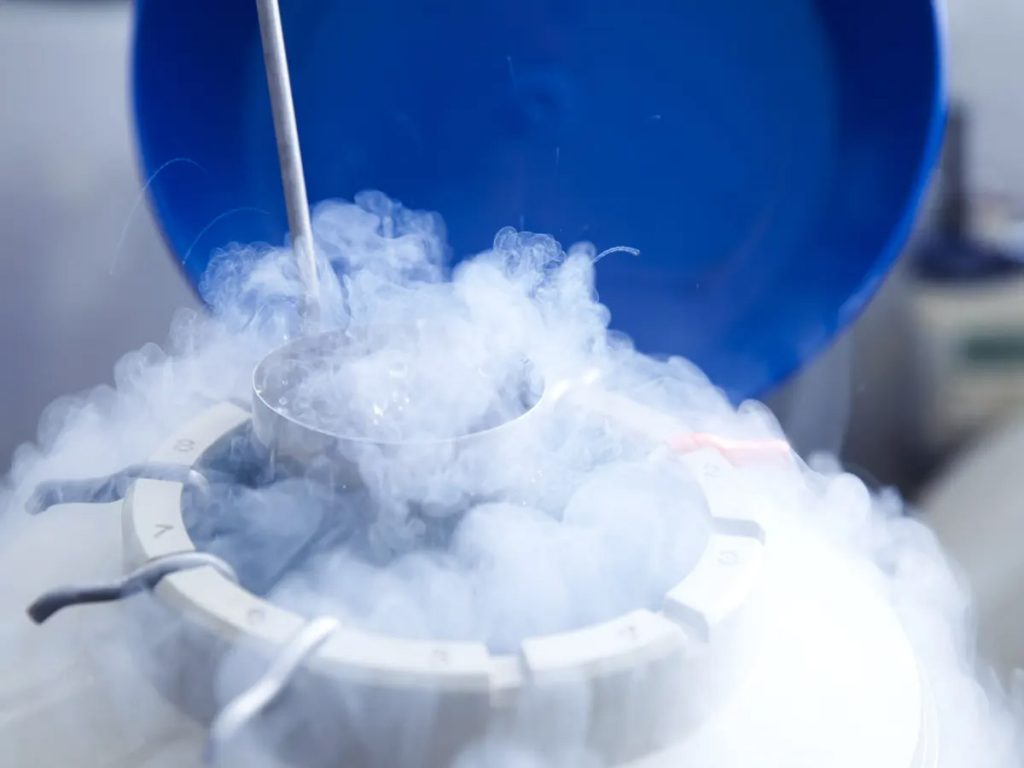
Once in the laboratory, the eggs undergo a freezing procedure called vitrification. This involves rapid freezing the eggs using a process that extracts fluid from the eggs to prevent potentially damaging ice crystal formation. Once vitrified, eggs may be stored for many years.
Egg freezing success rates
Vitrification for egg freezing is a relatively new procedure and it is too early to be able to give precise figures for the chance of pregnancy after freezing, future thawing and fertilization. The chance of success is largely determined by the woman’s age at the time of freezing.
success rates for egg freezing would be
for a woman aged 35 or under, one stimulated cycle would result in the collection of 10 – 12 eggs of which 7 – 9 would be suitable for vitrification and storage
Approximately 80-90% of eggs would survive warming in the future
Approximately 50-80% of surviving eggs would fertilize
Approximately 80-90% of fertilized eggs would develop into embryos
A single embryo would have a 20-35% change of developing into a pregnancy
Success rates are lower for women over 35 and egg freezing in women over the age of 38 is unlikely to lead to a pregnancy.
The expected success of the procedure can be ascertained from an initial assessment of the ovarian reserve using a blood test for Anti-Mullerian Hormone (AMH) and an ultrasound scan of the ovaries and uterus. The AMH test can provide insight into the quantity of eggs remaining, although it does not give information about the quality of the eggs.
Egg freezing cannot ever be guaranteed to lead to a pregnancy and birth of a healthy baby later in life. Women who freeze their eggs may not know the outcome for many years and may lose the opportunity to have a baby naturally.
?How safe is it
IVF is mostly very safe, although some women do experience side effects from their fertility drugs. These are usually mild, but in extreme cases women can develop ovarian hyperstimulation syndrome (OHSS), which is potentially fatal, so you should familiarize yourself with the symptoms.
It’s also important to know that as you get older, there is more risk of pregnancy-related complications and health problems to both you and your baby.